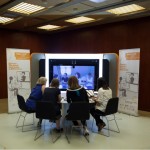
In the framework of the cycle Global Exchange of Craft Makers, a first session on “Are crafts a promising creative sector for development? Sharing thoughts and experiences” will be organised next 24 May from 17h to 18h30 connecting cities of Évora, Lisbon, and Rio de Janeiro.
During this session, special speakers and participants will analyse the opportunities and challenges this sector presents in each of the participating countries for the development of their societies. Different development dimensions, cultural, education, economic and social, will be addressed during the session, which will serve as introductory session for the whole cycle.
In the networked society the lack of information is not a problem, the problem is the lack of good information, or being able to choose the more accurate one, some say. Media literacy is found important for several reasons. Should journalists and newsrooms have a responsibility to work towards it? If so, who besides journalists should work for it? And how could be done?
If choosing what vocabulary to use when the conversations are about the migrant crisis is important? What does it means to be a refugee nowadays? and is Europe up to the big challenge of the migrant crisis?
Dialogue Cafe Lisbon (Calouste Gulbekian Foundation) and Dialogue Cafe Rio de Janeiro (UCAM Candido Mendes University) will bring experts and journalists to discuss, among many other participants, and debate on the topic. Portuguese will be the language used during the debate.
In the framework of the cycle on Youth Human Rights Activism: Beyond Social Media a third and last session will be organised in order to present smart initiatives promoting youth activism and networking using new technologies and social media.
The session will take place on 10 March froom 15h00 to 16h30 (London time) and will join in debate Dialogue Café Lisbon (Calouste Gulbenkian Foundation) and Dialogue Café Rio de Janeiro (UCAM University).
In the framework of the cycle “Youth Human Rights Activism: beyond social media“, Dialogue Cafe Association is organising a second session focused on social media tools for activism and social change.
“Creative industries are those industries that have their origin in individual creativity, skill, and talent, and have potential for job creation through the generation and exploitation of ideas or imagination. Using this broad definition, creative industries range from advertising and social media to the likes of agribusiness, design, and handicrafts. Creative industries provide a platform to support the sustained empowerment of women. In communities across the world, rich cultural value and traditional designs have been protected and nurtured by women through creative industries.”[1]
The rise of the creative industries presents significant opportunities for transforming women´s energy into new ideas, organisation and a future vision for societies. The sessions will address some of the critical policy approaches that are required to promote creative entrepreneurship among women and young women.
With this purpose, the Dialogue Café Association offer its network to address the challenges faced by women in terms of employment and opportunities for entrepreneurship within the creative sector and to reinforce networking opportunities.
Based on the main recommendations identified by international organisations such as UNCTAD[1], UNIDO and UNESCO, the Dialogue Café Network organises a session on women´s empowerment through creative industries focused on the following topics:
Women´s participation in Creative Industries.
Creative Young Women: sharing testimonials, needs and added value.
Good practices, Partnerships and Networking.
PROGRAMME
The session will take place next Thursday 24 March from 15h00 to 16h30 London time connecting DCs in Évora, Lisbon, Novi Pazar and Rio de Janeiro.
[2] “Building a Digital Economy: The importance of saving jobs in the EU’s creative industries”, TERA Consultants, March 2010.
[3] Commission Recommendation on the digitalization and online accessibility of cultural material and digital preservation, C(2011) 7579 final, 27.10.2011