“Creative industries are those industries that have their origin in individual creativity, skill, and talent, and have potential for job creation through the generation and exploitation of ideas or imagination. Using this broad definition, creative industries range from advertising and social media to the likes of agribusiness, design, and handicrafts. Creative industries provide a platform to support the sustained empowerment of women. In communities across the world, rich cultural value and traditional designs have been protected and nurtured by women through creative industries.”[1]
The rise of the creative industries presents significant opportunities for transforming women´s energy into new ideas, organisation and a future vision for societies. The sessions will address some of the critical policy approaches that are required to promote creative entrepreneurship among women and young women.
With this purpose, the Dialogue Café Association offer its network to address the challenges faced by women in terms of employment and opportunities for entrepreneurship within the creative sector and to reinforce networking opportunities.
Based on the main recommendations identified by international organisations such as UNCTAD[1], UNIDO and UNESCO, the Dialogue Café Network organises a session on women´s empowerment through creative industries focused on the following topics:
Women´s participation in Creative Industries.
Creative Young Women: sharing testimonials, needs and added value.
Good practices, Partnerships and Networking.
PROGRAMME
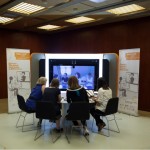
The session will take place next Thursday 24 March from 15h00 to 16h30 London time connecting DCs in Évora, Lisbon, Novi Pazar and Rio de Janeiro.
[2] “Building a Digital Economy: The importance of saving jobs in the EU’s creative industries”, TERA Consultants, March 2010.
[3] Commission Recommendation on the digitalization and online accessibility of cultural material and digital preservation, C(2011) 7579 final, 27.10.2011
In the framework of the Cycle on Youth Human Rights Activism: beyond social media, a first session will be addressing the challenges and the opportunities young activists found by using social media and new communication tools. This session will allow us to introduce the following sessions of the cycle.
The round table will take place on 25 February 2016 from 15h00 to 16h30 London time.
Nowadays because of the development of ICT and the global interconnectivity, youth have more access to information about global issues. Indeed, technology and the use of digital media have changed the way youth participate in activism globally, and youth are more active in media than older generations.
Youth activism and civic participation in social change focuses more on issue-oriented activism. People under the age of 18 comprise 46% of the global population, and these youth played a crucial role around the world in promoting human rights, equality and equity. They serve to strengthen already existing networks of political and social relationships among activists offline. Media activism among youth can be linked to the way youth protest and create communities online over specific issues and social connections. Social Media has become a primary organising tool for political and social movements globally. These movements through social media have been attributed to the interest and involvement of younger generations. However, beyond social media, new ICT technology is offering new opportunities and challenges to young social changers and activists.
This programme is aimed at strengthening Youth Human Rights Activism for social change. This cycle has as objective to analyse and to promote opportunities for developing skills of youth activists on Human Rights activism, social media, civic participation, cooperation and networking.
For this purpose Dialogue Cafe Network (DC Évora, DC Lisbon, DC Novi Pazar and DC Rio de Janeiro) is organising a cycle of three sessions as follows:
Session 1 – Round-table: Youth Activism and Human Rights: Challenges and Added Value (25 February 2016 – from 15h00 to 16h30 London time)
Session 2 – Workshop: Social media tools for activism (micro-blogging, online platforms, blogging). (03 March 2016 – from 15h00 to 16h30 London time)
Session 3 – Workshop: Why are social networks powerful tools for causes and campaigns? Working together, Launching a Campaign. (10 March 2016 – from 15h00 to 16h30 London time)
For more information, contact us at info(at)dialoguecafe.org
With the aim of supporting social entrepreneurship in creative sectors, the Dialogue Café Association offer its network to address the challenges faced by creative and social entrepreneurs, provide networking and partnerships opportunities, promote research and reflection, share good practices and case studies as well as support the development of social entrepreneur’s competences.
First session on “Censorship in a global and changing world: religion, politics and economics”.
In this framework, a first session untitled “Exchanging thoughts on creative hubs and entrepreneurship as vehicle for social change”, will allow us to introduce the main expected outcomes of this cycle of sessions and identify the challenges and opportunities of using creative industries as a tool for social entrepreneurship. Experts, entrepreneurs, makers, organisations promoting social entrepreneurship in the field of creative industries will join us in different cities of the Dialogue Café Network and take the floor to discuss about these issues.
The first session of this cycle on creative hubs and social entrepreneurship will take place next 20 October 2015 from 15h to 16h30 (London time).
Speakers:
DC Lisbon:
Cristina Farinha, Executive Director of ADDICT, Agency for the development of culture and creative industries north of Portugal
Susana António, Fermenta NGO, Founder of A Avó veio Trabalhar
DC Novi Pazar:
Dženan Narović, NVO Front
Samir Kacapor, SEDA (Regional Development Agency of Sandžak
Tales are typically interlaced with the inspired narrative of a society, embedding its historical origin, conveying its cultural representation, and often emitting its cultural beliefs. These are commonly constructed with identifiable universal common denominators, such as good vs. evil. As such, tales frequently become an archival reference of a culture, providing a looking-glass to the civilisation they were produced in. In Interpretation of Fairytales, Marie-Louise Von Franz states that fairytales “mirror the basic structure of the psyche” and provide the most elementary archetypal insight into the collective unconscious.
The Dialogue Cafe Association organises this workshop with the aim of promoting to intercultural exchange through the sharing of tales from the participants’ homelands, and re-enacting extracts or scenarios of these tales to create a new – and culturally-shared – tale.
This workshop will deal with the topic of fairytales and other tales as a vessel of the collective unconscious cultural memory of the participants, with the prospect of imparting awareness of both cultural distinction and resemblance, through the construction of a shared tale.
The workshop will take place on 21, 25, 27 August 2015 and will connect Dialogue Cafés based in Lisbon and Rio de Janeiro.