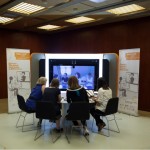
We’re looking for dynamic, entrepreneurial and creative partners to host and manage a Dialogue Café in London. This is truly an amazing opportunity to take part in a groundbreaking social venture and to represent London in the global Dialogue Café network.
There is no typical Dialogue Café partner – we’re working with schools, universities, galleries and museums, local governments, foundations, social innovation centres and community hubs. The three things that Dialogue Café partners have in common are: creative, entrepreneurial people to manage the Dialogue Café; a space (60-80m²) which is open, accessible and easy to get to; links to networks who would be interested in taking part in and using Dialogue Café.
The DC is ready to be moved and installed. We provide the equipment and will integrate you in the network.
We welcome expressions of interest and proposals from any group or organization that could provide one, two or all of the above.
For more information contact us at: helenabarroco(at)casadoregalo.pt or daliasendra(at)casadoregalo.pt
The main topics discussed and reported by the media can and should be part of a greater discussion. In a globalised and networked world the impact of news and it’s reflections of society can be the subject of very interesting and worthy discussions, trying to grasp the differences and similarities between geographical areas and countries in what regards several topics. Getting a critical approach to media is more and more important to make sense of the puzzle that is information in the digital age. Are there differences in the way the media from different countries or regions approaches the same subjects? What are those differences? Can ordinary citizens see those differences?
Dialogue Cafe Association in partnership with Centre for Research and Studies in Sociology from the University Institute of Lisbon (ISCTE-IUL) is launching a new cycle of global conversations with the aims of, firstly, discussing different media approaches to global themes, according to media’s location; secondly, contributing to understand if media outlets are in some way biased by their location; thirdly, contributing to get people from several places talking about their media outlets approaches to global themes.
In order to create a critical view on news and media outlets approach to global themes, raise awareness to some of the most highlighted subjects reported by media outlets, all over the world, and gather people with several backgrounds and nationalities on relevant and global issues in discussion, several global conversations will be organised from April to December 2016.
Students, journalists, academics, politicians and civil society in general are invited to join us and share their views on the global topics discussed.
2nd Session DC – Changing Societies, Changing Journalism
Sessions
The sessions that will be organised are:
Refugee or migrant: what a difference a word can make? 14 April 2016
Global radicalisation, local suffering, May 2016
Multicultural societies, July 2016
Europe in the XXI Century: is the European crisis eternal? , October
Open Knowledge – are the public and the private sectors ready for this challenge? , November 2016.
Since 2016 Dialogue Café is promoting exchanges and dialogue between different crafts makers around the world. In this framework, challenges and opportunities are being identified and networking opportunities developed with the aim of promoting knowledge sharing in the field of crafts making and strengthen creative makers´ capacities and opportunities.
Using Dialogue Cafés and Cisco Tele Presence suites we could connect a wide variety of stakeholders from a number of cities across the world to meet and discuss in real-time. Activities will alternate, conferences, debates, exchanges and meetings. The focus of these activities would be to explore:
Each of these sessions would connect at least 3 countries and would bring together artisans, associations, creative entrepreneurs, companies, designers, galleries, makers, municipalities, researchers, policy makers, think tanks, research centres, innovation agencies, chambers of commerce, social enterprises and business support agencies focusing on SMEs. These workshops will be organised by Dialogue Café Association and Network in partnership with relevant stakeholders (see list of potential partners below).
“Creative industries are those industries that have their origin in individual creativity, skill, and talent, and have potential for job creation through the generation and exploitation of ideas or imagination. Using this broad definition, creative industries range from advertising and social media to the likes of agribusiness, design, and handicrafts. Creative industries provide a platform to support the sustained empowerment of women. In communities across the world, rich cultural value and traditional designs have been protected and nurtured by women through creative industries.”[1]
The rise of the creative industries presents significant opportunities for transforming women´s energy into new ideas, organisation and a future vision for societies. The sessions will address some of the critical policy approaches that are required to promote creative entrepreneurship among women and young women.
With this purpose, the Dialogue Café Association offer its network to address the challenges faced by women in terms of employment and opportunities for entrepreneurship within the creative sector and to reinforce networking opportunities.
Based on the main recommendations identified by international organisations such as UNCTAD[1], UNIDO and UNESCO, the Dialogue Café Network organises a session on women´s empowerment through creative industries focused on the following topics:
Women´s participation in Creative Industries.
Creative Young Women: sharing testimonials, needs and added value.
Good practices, Partnerships and Networking.
PROGRAMME
The session will take place next Thursday 24 March from 15h00 to 16h30 London time connecting DCs in Évora, Lisbon, Novi Pazar and Rio de Janeiro.
[2] “Building a Digital Economy: The importance of saving jobs in the EU’s creative industries”, TERA Consultants, March 2010.
[3] Commission Recommendation on the digitalization and online accessibility of cultural material and digital preservation, C(2011) 7579 final, 27.10.2011
Nowadays because of the development of ICT and the global interconnectivity, youth have more access to information about global issues. Indeed, technology and the use of digital media have changed the way youth participate in activism globally, and youth are more active in media than older generations.
Youth activism and civic participation in social change focuses more on issue-oriented activism. People under the age of 18 comprise 46% of the global population, and these youth played a crucial role around the world in promoting human rights, equality and equity. They serve to strengthen already existing networks of political and social relationships among activists offline. Media activism among youth can be linked to the way youth protest and create communities online over specific issues and social connections. Social Media has become a primary organising tool for political and social movements globally. These movements through social media have been attributed to the interest and involvement of younger generations. However, beyond social media, new ICT technology is offering new opportunities and challenges to young social changers and activists.
This programme is aimed at strengthening Youth Human Rights Activism for social change. This cycle has as objective to analyse and to promote opportunities for developing skills of youth activists on Human Rights activism, social media, civic participation, cooperation and networking.
For this purpose Dialogue Cafe Network (DC Évora, DC Lisbon, DC Novi Pazar and DC Rio de Janeiro) is organising a cycle of three sessions as follows:
Session 1 – Round-table: Youth Activism and Human Rights: Challenges and Added Value (25 February 2016 – from 15h00 to 16h30 London time)
Session 2 – Workshop: Social media tools for activism (micro-blogging, online platforms, blogging). (03 March 2016 – from 15h00 to 16h30 London time)
Session 3 – Workshop: Why are social networks powerful tools for causes and campaigns? Working together, Launching a Campaign. (10 March 2016 – from 15h00 to 16h30 London time)
For more information, contact us at info(at)dialoguecafe.org